


Late breaking caused TGV derailment finds initial investigation
Posted: 20 November 2015 | | 3 comments
Last weekend’s TGV derailment on the LGV Est line near Strasbourg was caused by excessive speed and late breaking finds initial investigation carried out by French operator SNCF. On Thursday 19 November 2015, SNCF president Guillaume Pepy confirmed an initial investigation into the derailment of a TGV Euroduplex test train on Saturday 14 November was […]
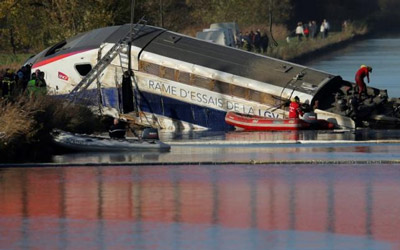
Last weekend’s TGV derailment on the LGV Est line near Strasbourg was caused by excessive speed and late breaking finds initial investigation carried out by French operator SNCF.
(Image: Reuters)
On Thursday 19 November 2015, SNCF president Guillaume Pepy confirmed an initial investigation into the derailment of a TGV Euroduplex test train on Saturday 14 November was caused by late breaking due to excessive speed on a bend near Eckwersheim, 12km from Strasburg. SNCF investigations also revealed that no abnormalities were detected in the condition and operation of infrastructure and no failures were identified in technical tests and traffic management.
TGV derailment caused by vehicle approaching bend at 265 km/hr instead of 176 km/hr
The high speed TGV Euroduplex set 744 train carrying fifty-three people, including technicians, railway workers and their families, was undergoing a trial on the second section LGV Est line between Paris and Strasbourg. According to SNCF’s initial investigation, the vehicle approached a bend on the Eckwersheim stretch at 265 km/hr instead of 176 km/hr. At the time of derailment the high-speed train had reduced its speed to 243 km/hr. Tests on the line allow for a 10 percent increase in speed above the set limit, however, SNCF state that brakes should have been applied at least 1km earlier to reduce speed before entering the bend.
Join our free webinar: Rail cyber-security in a time of technological and regulatory transformation
Join our expert panel, including speakers from Nokia and Siemens Mobility, to explore the critical convergence of cybersecurity and 5G rail comms.
Date: 3 Dec | Time: 15:00 GMT
Can’t attend live? No worries – register to receive the recording post-event.
SNCF will establish an expertise committee to present conclusions and recommendations within the next six months and produce an interim report in 3 months.
In the interim SNCF has halted high speed test runs and will prohibit unauthorised persons on board test runs and at test sites.
Investigations into the derailment, which cost the lives of 11 people, will continue by the Office of Land Transport Accident Inquiries (BEA-TT) and a judicial inquiry. The opening of the line, scheduled for April 2016 is expected to be delayed.
Stay Connected with Global Railway Review — Subscribe for Free!
Get exclusive access to the latest rail industry insights from Global Railway Review — all tailored to your interests.
✅ Expert-Led Webinars – Gain insights from global industry leaders
✅ Weekly News & Reports – Rail project updates, thought leadership, and exclusive interviews
✅ Partner Innovations – Discover cutting-edge rail technologies
✅ Print/Digital Magazine – Enjoy two in-depth issues per year, packed with expert content
Choose the updates that matter most to you. Sign up now to stay informed, inspired, and connected — all for free!
Thank you for being part of our community. Let’s keep shaping the future of rail together!

Were any children killed?
Um, braking?
Yup !